Research

Research Projects and Simulation Programmes

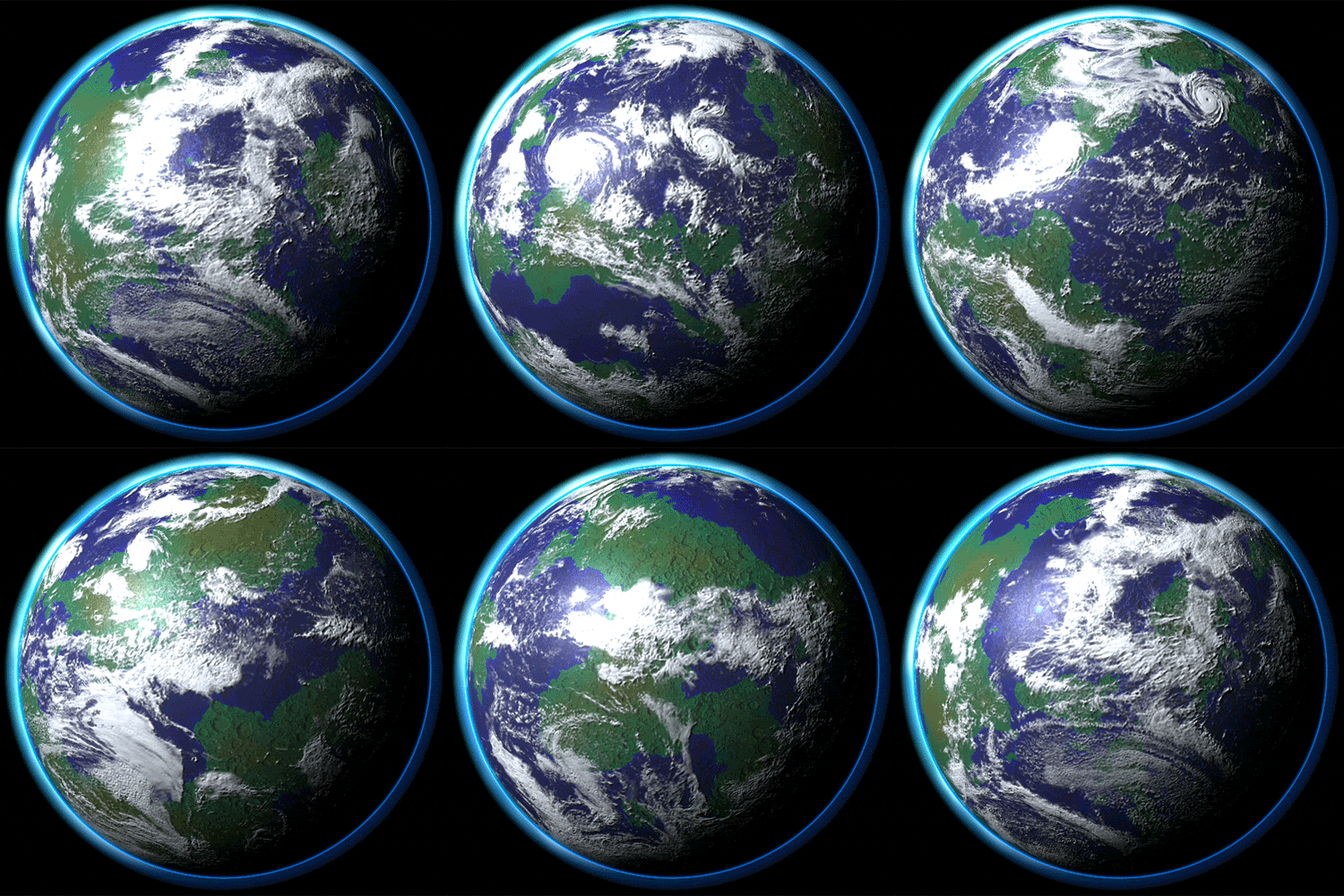
OASIS research combines model development, atmospheric dynamics, spectroscopy, and retrieval science to build predictive frameworks for planetary climate interpretation.

OASIS – Planet Climate Simulator

OASIS – Planet Climate Simulator

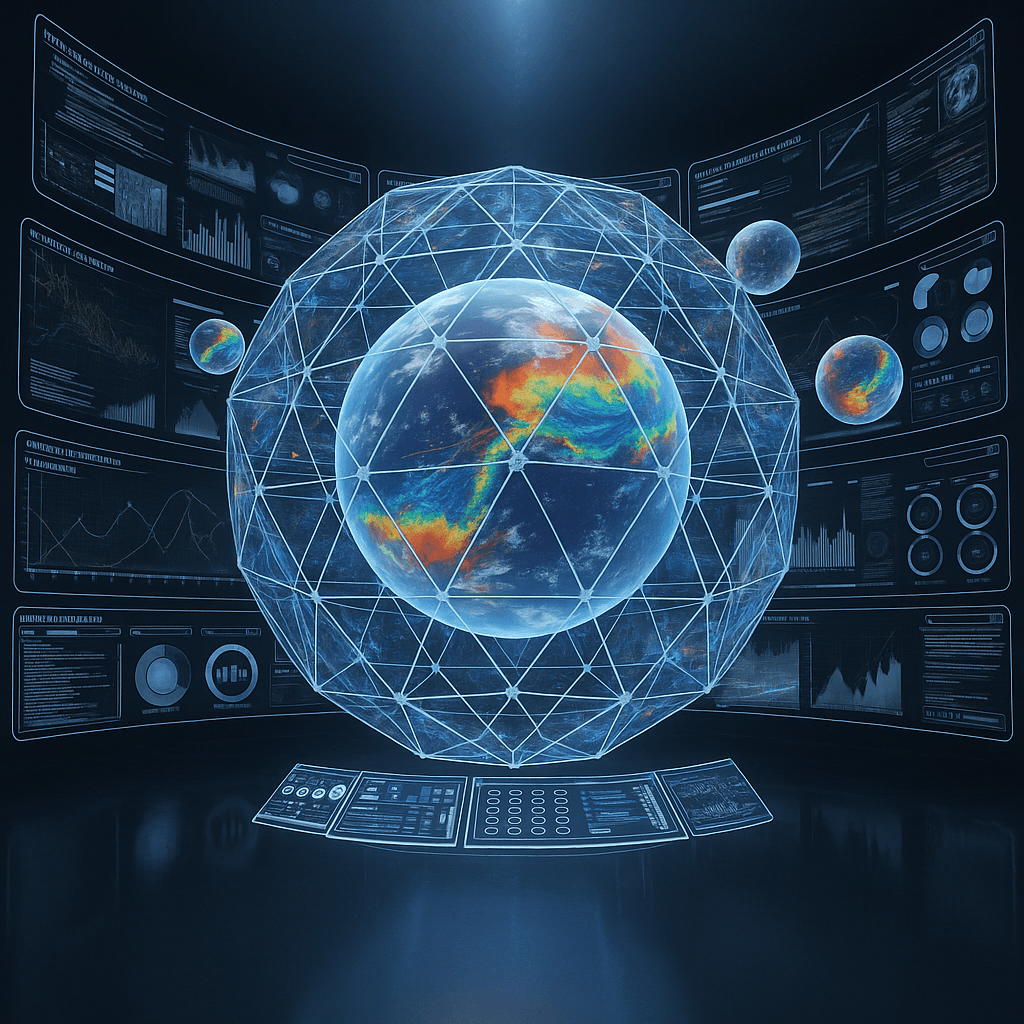
OASIS is being developed as a universal planetary climate framework that self-consistently couples dynamics, chemistry, radiation, and additional physical processes into one scalable model architecture.

  • Designed to study environments across Earth, Solar System planets, and exoplanets.
  • Built to support physically consistent interpretation of current and future observations.
  • Funded by Horizon Europe Guarantee (UKRI), Horizon Europe – Marie Sklodowska-Curie Actions, and NVIDIA.
THOR – Dynamical Core

THOR – Dynamical Core

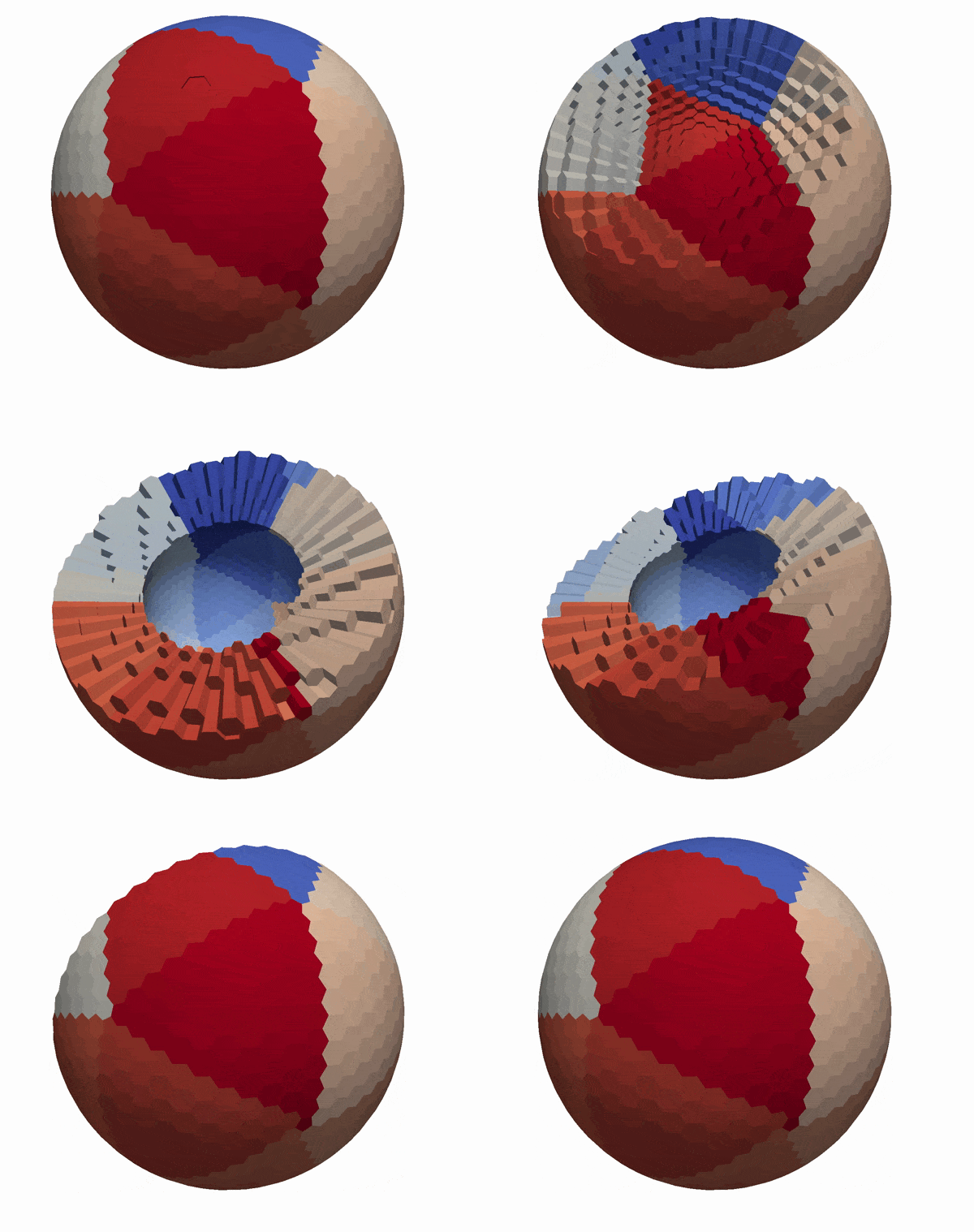
THOR solves fully compressible non-hydrostatic equations on an icosahedral grid and forms the dynamical core backbone for 3D atmospheric circulation in OASIS.

  • Supports standalone atmospheric studies and full OASIS coupling.
  • Engineered for diverse planetary regimes without Earth-only approximations.
  • Initial versions are open-source, without OASIS complexities.
Atmospheric Dynamics and Chemistry

Atmospheric Dynamics and Chemistry

The team investigates atmospheric jets, turbulence, and circulation-chemistry interactions using predictive 3D numerical tools for planetary environments.

  • Cloud and chemistry transport prediction from circulation dynamics.
  • Cross-domain methods applied from Solar System planets to exoplanets atmospheres.
  • Focused on physically interpretable dynamics for observational constraints.
The Hot Rocks Survey

The Hot Rocks Survey

Large JWST programme probing irradiated terrestrial exoplanets around nearby M dwarfs to test for atmospheres and rocky surface compositions.

  • Ensemble analysis across multiple targets to isolate governing processes.
  • Joint interpretation between simulation, retrieval, and telescope datasets.
  • Focused on rocky exoplanet atmospheric detectability and diversity.
Ocean and Sea-Ice Dynamics on Earth and the Icy Moons of our Solar System

Ocean and Sea-Ice Dynamics on Earth and the Icy Moons of our Solar System

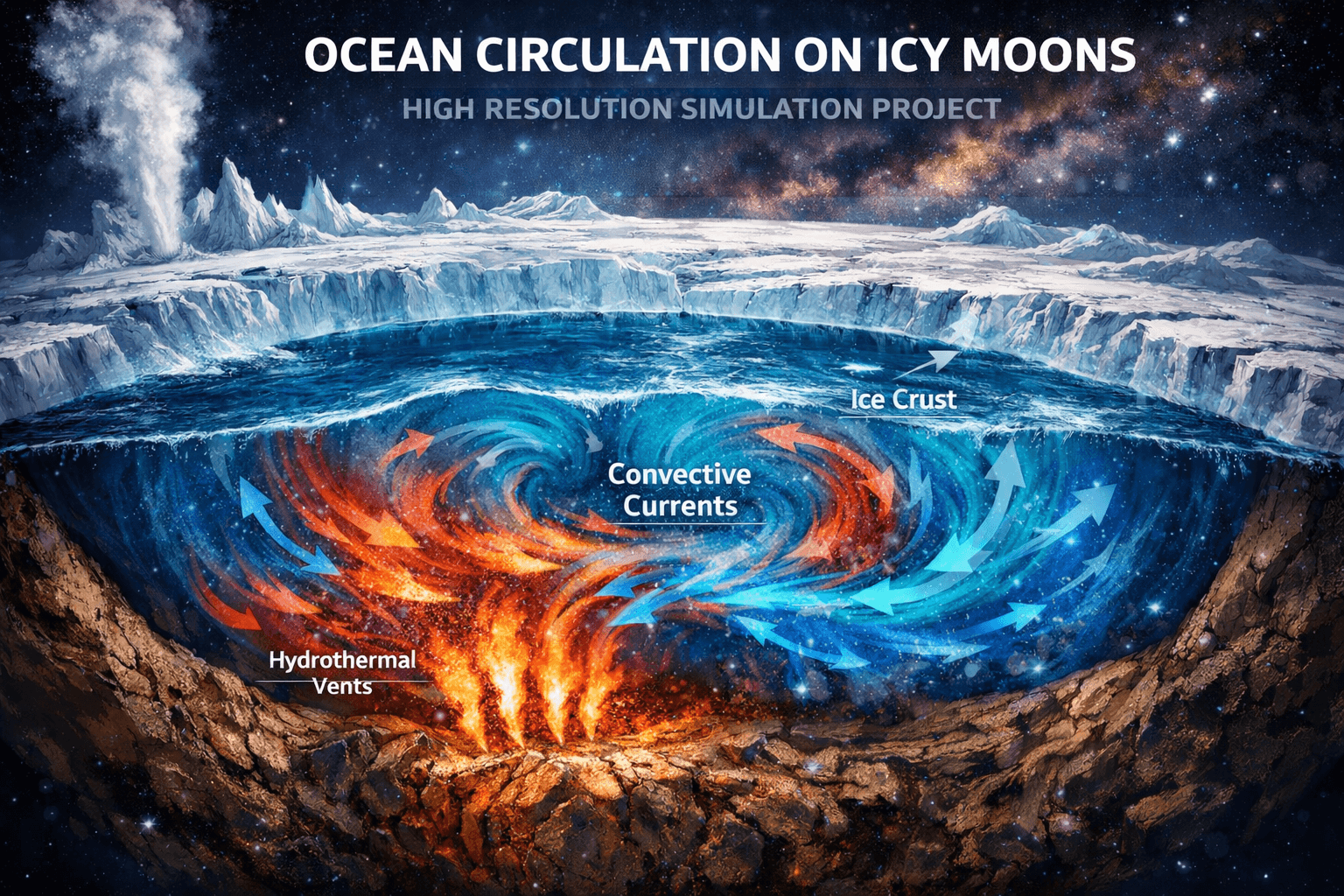
High-resolution simulations of ocean and sea-ice dynamics on Earth, Enceladus, and Europa are used to connect physical transport processes with current observations and improve interpretation of subsurface ocean behaviour.

  • High-resolution modelling of circulation and sea-ice interactions for Enceladus and Europa.
  • Observation-connected workflows linking model diagnostics with current mission and telescope constraints.
  • Comparative ocean dynamics studies across Earth and icy moons to identify robust transport mechanisms.
Venus Climate and Comparative Planetology

Venus Climate and Comparative Planetology

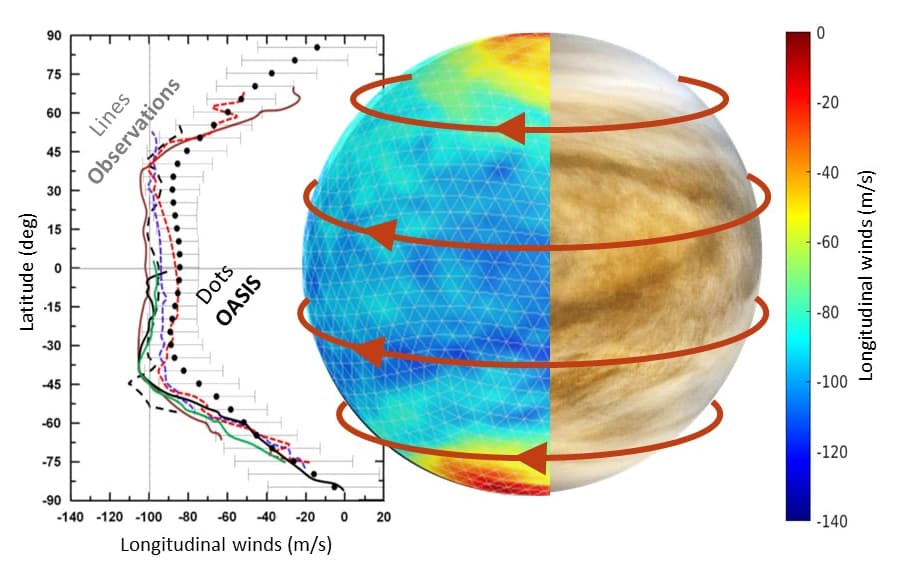
OASIS and associated models are used to study Venus atmospheric circulation and climate evolution across model hierarchies from 1D to full 3D.

  • High-fidelity simulations of Venus's extreme and complex climate.
  • Comparative Earth-Venus climate divergence studies.
  • Links present-day atmospheric dynamics with long-timescale climate evolution.
High-Resolution Spectroscopy and Retrieval

High-Resolution Spectroscopy and Retrieval

The team develops and applies retrieval pipelines to infer atmospheric properties from high-resolution spectroscopy with model-informed interpretation.

  • Golden-Retriever combines multiple datasets in a unified retrieval workflow.
  • Integrates Helios-K, FastChem, and nested samplers with OASIS components.
  • Optimized model pathways for rapid interaction with sampling algorithms.